


Cart
- Cart Empty!

- Appliances
- Notebook/ Tablet Pc/ E-book
- Software Esd
- Audio/ Video/ Multimedia
- Books
- Cables & Accessories
- Communication & Networking
- Controller & Interface
- Imaging & Photography
- Input Devices
- Monitor & Display
- Motherboard/ Memory/ Processor
- Pc & Workstation
- Power Components & Protection
- Printer/ Aio/ Copier/ Fax
- Projectors
- Servers
- Software
- Storage
- Telephony/ Handhelds
Every effort has been made to ensure the accuracy of all information contained herein. e-nitiative shall not be liable for any changes resulting in wrong product description, tax code and/or price. The shown information (specifications, prices, taxes) should be considered as an indication and can be changed at any moment and without any prior notice.

ADVANCE COMPUTER CENTRE LTD
59 GEORGE LANE
E18 1JJ LONDON
UK
Telephone : 02085188353
VAT : 506794623


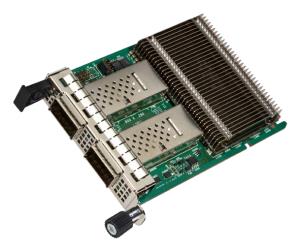
Ethernet Network Adapter Ocp3.0 E835-cqda2 Single Pci-e
£687.98
| Part Number: | E835CQDA2OC3 |
| Language: | IN |
Product Details
Introduction
Intel® Trusted Execution Technology
Intel® Trusted Execution Technology for safer computing is a versatile set of hardware extensions to Intel® processors and chipsets that enhance the digital office platform with security capabilities such as measured launch and protected execution. It enables an environment where applications can run within their own space, protected from all other software on the system.
iWARP/RDMA
iWARP delivers converged, low-latency fabric services to data centers through Remote Direct Memory Access (RDMA) over Ethernet. The key iWARP components that deliver low-latency are Kernel Bypass, Direct Data Placement, and Transport Acceleration.
Intel® Data Direct I/O Technology
Intel® Data Direct I/O Technology is a platform technology that improves I/O data processing efficiency for data delivery and data consumption from I/O devices. With Intel DDIO, Intel® Server Adapters and controllers talk directly to the processor cache without a detour via system memory, reducing latency, increasing system I/O bandwidth, and reducing power consumption.
PCI-SIG* SR-IOV Capable
Single-Root I/O Virtualization (SR-IOV) involves natively (directly) sharing a single I/O resource between multiple virtual machines. SR-IOV provides a mechanism by which a Single Root Function (for example a single Ethernet Port) can appear to be multiple separate physical devices.
Flexible Port Partitioning
Flexible Port Partitioning (FPP) technology utilizes industry standard PCI SIG SR-IOV to efficiently divide your physical Ethernet device into multiple virtual devices, providing Quality of Service by ensuring each process is assigned to a Virtual Function and is provided a fair share of the bandwidth.
Virtual Machine Device Queues (VMDq)
Virtual Machine Device Queues (VMDq) is a technology designed to offload some of the switching done in the VMM (Virtual Machine Monitor) to networking hardware specifically designed for this function. VMDq drastically reduces overhead associated with I/O switching in the VMM which greatly improves throughput and overall system performance
Ports & interfaces
Connectivity technology
Wired
Host interface
PCI Express
Interface
Fiber
Fiber ports quantity
2
Fiber optic connector
QSFP28
PCI version
5.0
PCI Card form factor
Full-height (low-profile)
Network
Maximum data transfer rate
200000 Mbit/s
Networking standards
IEEE 1588
Ethernet LAN
Yes
Ethernet interface type
10 Gigabit Ethernet, 25 Gigabit Ethernet, 50 Gigabit Ethernet, 100 Gigabit Ethernet, 200 Gigabit Ethernet
Ethernet LAN data rates
10000,25000,50000,100000,200000 Mbit/s
iSCSI support
Yes
Design
Component for
Server
Internal
Yes
Form factor
OCP 3.0
Operational conditions
Operating temperature (T-T)
0 - 65 °C
Storage temperature (T-T)
-40 - 70 °C
Technical details
Compliance certificates
CE, ICES, KCC, RCM, UKCA, BSMI, Federal Communications Commission (FCC), RoHS
Other features
Market segment
Server
Intel Virtual Machine Device Queues (VMDq)
Yes
PCI-SIG* SR-IOV Capable
Yes
On-chip QoS and Traffic Management
Yes
Intel Flexible Port Partitioning
Yes
Intelligent Offloads
Yes
iWARP/RDMA
Yes
Intel Data Direct I/O Technology
Yes
Intel Virtualization Technology for Connectivity (VT-c)
Yes
Storage Over Ethernet
iSCSI, NFS
Ethernet adapter ARK ID
245159
Intel Trusted Execution Technology
No
Embedded options available
No
Launch date
Q1'26
Network interface card cable medium
Copper, Fiber
Product brief URL
https://cdrdv2.intel.com/v1/dl/getContent/834085
Status
Launched
Export Control Classification Number (ECCN)
5A992.C
Commodity Classification Automated Tracking System (CCATS)
740.17B1
Bracket height
OCP 3.0


